Showing posts with label Microscope. Show all posts

Monday, 28 January 2013

Rotifers-The wheeled animals

We all know that there are vast numbers of microorganisms around us and the most commonly found one are the rotifers. Rotifers have been discovered back then in 17 century by Antony Ven Lewenhook.
Rotifers are the miniature multi-celled (below 1000 cells) microorganism found in all the places of water. These are the tiniest members of the group of multicellular organisms to which we, humans belong. They are mostly about 0.1 to 0.5 mm long with a crown like ciliated structure called corona at the front. They loco mote through contracting and stretching its body.


A classic rotifer has a brain, digestive system, excretory system and reproductive system. Rotifers are known as wheel animals as the corona around the mouth resemble wheel in motion i.e. the two circles of constantly beating cilia for grabbing food giving the impression of rotating wheels. Sometimes these wheels-like-thing also act as propellers for moving the organism from one place to another.

Rotifers feed on all organic matter, making them the most jubilant scavengers of aquatic environment.


Sunday, 27 January 2013

Microscopic view of our domestic vampires-Mosquitos

Mosquitos- a very common insect found in every corner of earth and unfortunately in my home too. I have always been mosquito’s favorite food among my family. So to have an intimate look of my blood lovers, I squashed a couple of mosquitos and studied them under my microscope. Here are a few microscopic snaps of the mosquito’s body parts.

                                             A mosquito’s Head and the tiny dots are its eyes.
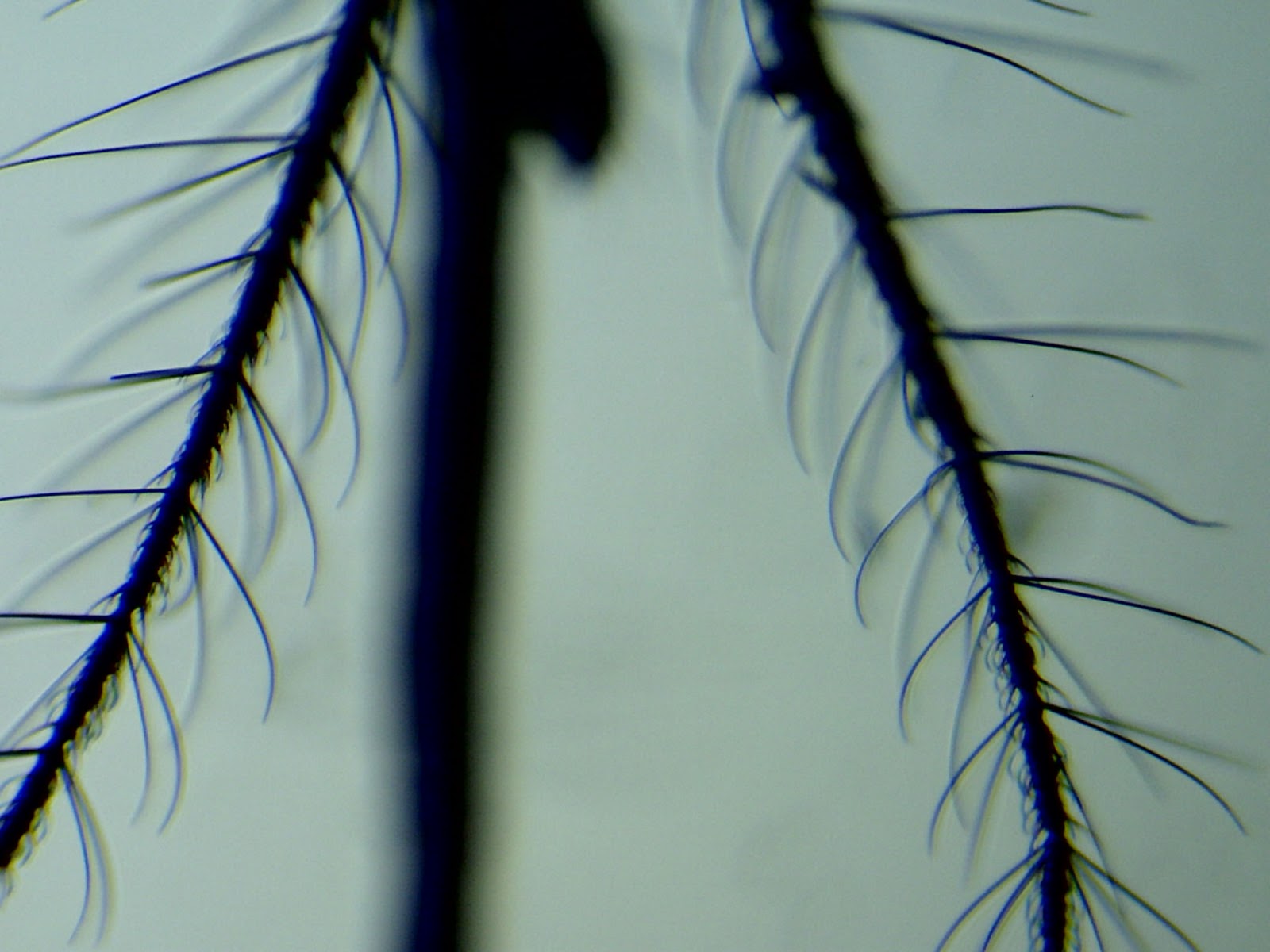
A pair of Antenna to sense the body odor
 
Closer view of antenna
 
Mosquitos Wing- mosquitos have a pair of wings which are covered with fine scales. These numerous small scales are located along the veins (the mid dark lines) and edges of the wings. They help to eliminate the dust and improve flying efficiency.
40X of Scales present on the edges of wings
 
Mosquitos Larvae- showing well developed head with pin point eyes and mouth brushes which are used for feeding on microorganisms and organic matter.
 
Mosquito larvae’s breathing tube- have a very special tube attached to the tail that reaches to the water surface for breathing.